
Submission for Call for Blogs
The Centre for Policy and Agenda, NUSRL (CPLAN)
Title:
Critical Analysis on Tariff Conflict in International Trade Dispute: Protectionism vs. Free Trade
Theme: International policies affecting India
Author:
Shashwat Choudhary
3RD Year Student | B.A. LL.B. (Hons.)
Research Interests:
Law and Public Policy, Geopolitics and International Law and Corporate Governance
Contact: +91 8375092878 | shashwat.choudhary@nusrlranchi.ac.in
Critical Analysis on Tariff Conflict in International Trade Dispute: Protectionism vs. Free Trade
“When goods don’t cross borders, soldiers will.”
- Frédéric Bastiat, Economist and writer
The post-war consensus on trade liberalization is over after a long-fought battle between economies. For seven decades, the global economy moved towards lower tariffs under the GATT and later the WTO, fostering unprecedented growth and creating complex global value chains (GVCs).[1] That era has given way to “neo-protectionism,” where tariffs are once again primary tools of economic statecraft and geopolitical pressure.[2] This shift was fuelled by anxieties over globalization and great power rivalry, directly challenges the rules-based trading order. At the heart of the crisis is the World Trade Organization, whose dispute settlement system, once its crown jewel, is paralyzed, leaving the global economy vulnerable to the beggar-thy-neighbour policies of the past.[3]
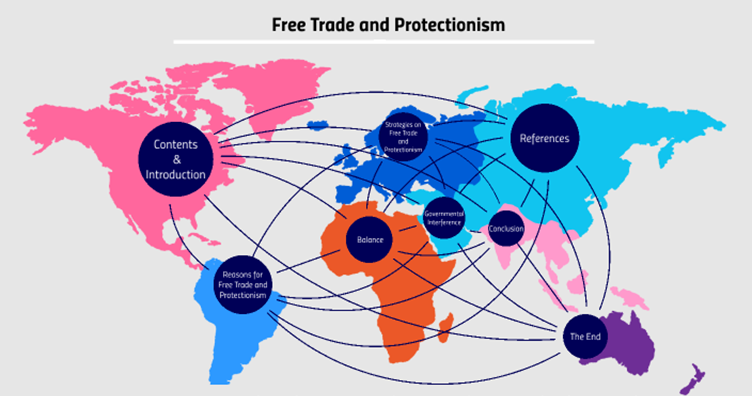
The Economic Reality of Modern Tariffs
While classical theories from David Ricardo forward champion free trade’s benefits, the reality of modern tariffs is stark.[4] The central question is “who pays?” The overwhelming empirical evidence from the 2018–2019 U.S.–China trade war provides a clear answer. Landmark studies by economists conclude that the cost of U.S. tariffs was passed on almost entirely to American importers, and subsequently to U.S. consumers and firms.[5] Foreign exporters did not absorb the cost. In a world of integrated GVCs, this effect is magnified, as tariffs on intermediate inputs act as a tax on a country’s own domestic manufacturing, undermining its competitiveness.[6]
The WTO’s Legal Edifice Under Siege
The WTO’s legal framework is designed to prevent such unilateral actions through core principles like tariff bindings (Article II) and non-discrimination (Article I). For decades, the national security exception in GATT Article XXI was treated as a political escape clause, effectively “self-judging” and beyond legal review.[7] This changed with the landmark 2019 Russia-Transit panel report, which established that the exception was not entirely self-judging and required an objective “emergency in international relations”.[8] However, this legal progress was swiftly neutralized by the authorities. When WTO panels applied this standard to rule against U.S. Section 232 steel and aluminum tariffs in 2022, the U.S. rejected the findings and appealed them “into the void” of the non-functional Appellate Body.[9] This maneuver, possible because the U.S. has blocked appointments to the body since 2019, has crippled the WTO’s enforcement mechanism, creating a “legal zombie apocalypse” where the rules exist but cannot be enforced.[10]
India at the Strategic Crossroads
For emerging economies like India, this new landscape is perilous. India’s trade policy is a delicate balance, using tariff flexibility under its “Make in India” initiative to build domestic industries like electronics assembly, while seeking deeper global integration.[11] This strategy has seen success but also created challenges, such as high tariffs on components that raise costs for domestic producers.[12] This vulnerability is starkly illustrated by a hypothetical scenario in 2025, the U.S. imposes steep geopolitical tariffs on India over its foreign policy choices. Economically, this would devastate India’s labour-intensive export sectors.[13] Legally, India would have a strong case at the WTO, as the U.S. justification would likely fail the Article XXI test. The U.S. could appeal the ruling into the void, rendering it unenforceable and demonstrating how power politics now trumps the rule of law in trade.[14]
A Tripartite Strategy for a Fragmenting World
In the face of a fragmenting global economy, a retreat into autarky is an untenable strategy. Instead, the imperative is to cultivate strategic resilience through a sophisticated, multi-pronged approach. This necessitates the concurrent fortification of the domestic economy via judicious tariff policies and regulatory reforms, the proactive diversification of trade partnerships alongside a concerted push for WTO reform, and a principled legal resistance to illegal tariffs to affirm the primacy of international rules. Recognizing the rules-based trading system as a global public good, its restoration ultimately depends on a renewed collective commitment to multilateralism. Until such a consensus re-emerges, however, strategic resilience remains the essential bridge to a more stable and integrated global economic future.
[1] Paul Krugman, Scale Economies, Product Differentiation, and the Pattern of Trade, 70 Am. Econ. Rev. 950 (1980).
[2] Marc J. Melitz, The Impact of Trade on Intra-Industry Reallocations and Aggregate Industry Productivity, 71 Econometrica 1695 (2003).
[3] S. Verma, The Tariff Trap: Why America’s Trade War with India Could Damage Its Own Economy and Alliances, Spmrf J. (Aug. 24, 2025).
[4] DAVID RICARDO, ON THE PRINCIPLES OF POLITICAL ECONOMY AND TAXATION (1817).
[5] Mary Amiti, Stephen J. Redding & David E. Weinstein, The Impact of the 2018 Trade War on U.S. Prices and Welfare, 34 J. Econ. Persp. 187 (2019).
[6] Pablo D. Fajgelbaum et al., The Return to Protectionism, 135 Q. J. Econ. 1 (2020).
[7] Panel Report, Russia—Measures Concerning Traffic in Transit, WTO Doc. WT/DS512/R (adopted Apr. 26, 2019).
[8] Panel Report, United States—Certain Measures on Steel and Aluminium Products, WTO Doc. WT/DS544/R (Dec. 9, 2022).
[9] OFFICE OF THE U.S. TRADE REPRESENTATIVE, Statement on WTO Panel Reports on Section 232 Tariffs on Steel and Aluminum (Press Release, Dec. 9, 2022).
[10] Alberto Cavallo et al., Tariff Pass-Through at the Border and at the Store: Evidence from U.S. Trade Policy, 111 Am. Econ. Rev. 127 (2021).
[11] WORLD TRADE ORG., Trade Policy Review: India, WTO Doc. WT/TPR/S/413 (2021).
[12] MINISTRY OF ELECTRONICS & INFO. TECH., GOV’T OF INDIA, Notification No. CG-DL-E-01042020-218990 (Apr. 1, 2020).
[13] Panel Report, India—Tariff Treatment on Certain Goods in the Information and Communications Technology Sector, WTO Doc. WT/DS582/R (Apr. 17, 2023).
[14] Appellate Body Report, India—Certain Measures Relating to Solar Cells and Solar Modules, WTO Doc. WT/DS456/AB/R (adopted Oct. 14, 2016).